My Child Started Stuttering. What Should I Do?
If your child has recently started stuttering, you're probably carrying a lot of questions. Did I cause this? Will my child always stutter? Should I be doing something differently?
These are some of the first questions many parents ask after noticing changes in their child's speech.
Our Minds Naturally Look Backward and Forward
When something unexpected happens with our children, our minds often go in one of two directions. We look backward, trying to understand why it happened, or we look forward, wondering what the future might hold.
Looking backward, we may find ourselves replaying the last few weeks or months. Was it because we moved? Was it because school started? Did I miss something? Did I do something wrong?
These are very natural questions. Many parents find themselves wondering if they somehow caused their child's stuttering. While it’s natural for a parent’s mind to wander in that direction, it’s simply not true. Parents do not cause stuttering.
Today we know that stuttering is a difference in the brain's timing and coordination of speech. It is not caused by nervousness, parenting style, or something we did wrong.
Our minds can also jump to the future. Will they be teased? Will they make friends? Will they always stutter?
Those are understandable questions too. Some of them simply take time to answer. But while we're waiting, there are meaningful ways we can begin supporting our children today.
Where to Begin
There are several meaningful ways we can begin supporting our children:
Learn about stuttering
Continue building a strong communication relationship
Seek professional guidance when we need it
We don't have to do everything at once. These are simply places we can begin.
Support Through Learning
One of the most helpful things we can do is learn about stuttering. Accurate information helps us separate common myths from what research and the experiences of people who stutter have taught us. As our understanding grows, fear and uncertainty can gradually be replaced with confidence.
The Stuttering Foundation is one of the resources I trust and frequently recommend. It is a nonprofit organization founded in 1947 that provides education and support for people who stutter, families, teachers, speech-language pathologists, physicians, and others who want to understand stuttering. Its materials draw from research, clinical experience, and the perspectives of people who stutter, and I have found them to be consistently thoughtful and balanced.
Families can find free articles, brochures, books, videos, podcasts, and other resources on topics such as early childhood stuttering, school-age concerns, speech therapy, talking with children about stuttering, and supporting children at home and at school.
FRIENDS: The National Association of Young People Who Stutter offers another kind of support. This organization provides opportunities for young people who stutter and their families to connect through events, workshops, and other programs. For some families, that sense of community and the opportunity to hear from other people who stutter can be especially meaningful.
These two resources offer different ways to learn. The Stuttering Foundation provides reliable educational information, while FRIENDS offers opportunities for community and connection.
Support Through Connection
When a child begins stuttering, it is natural for us to start paying closer attention to the way they speak. We may notice repetitions and blocks or find ourselves comparing one sentence to another and wondering whether speech sounded easier or harder.
That attention makes sense. Something has changed, and we're trying to understand it. But our child is telling us about the picture they drew, the video game they finally beat, the goal they scored, or the big idea they've been thinking about all day. When we interrupt them, correct them, or finish their sentences, we can rob them of the joy in communication.
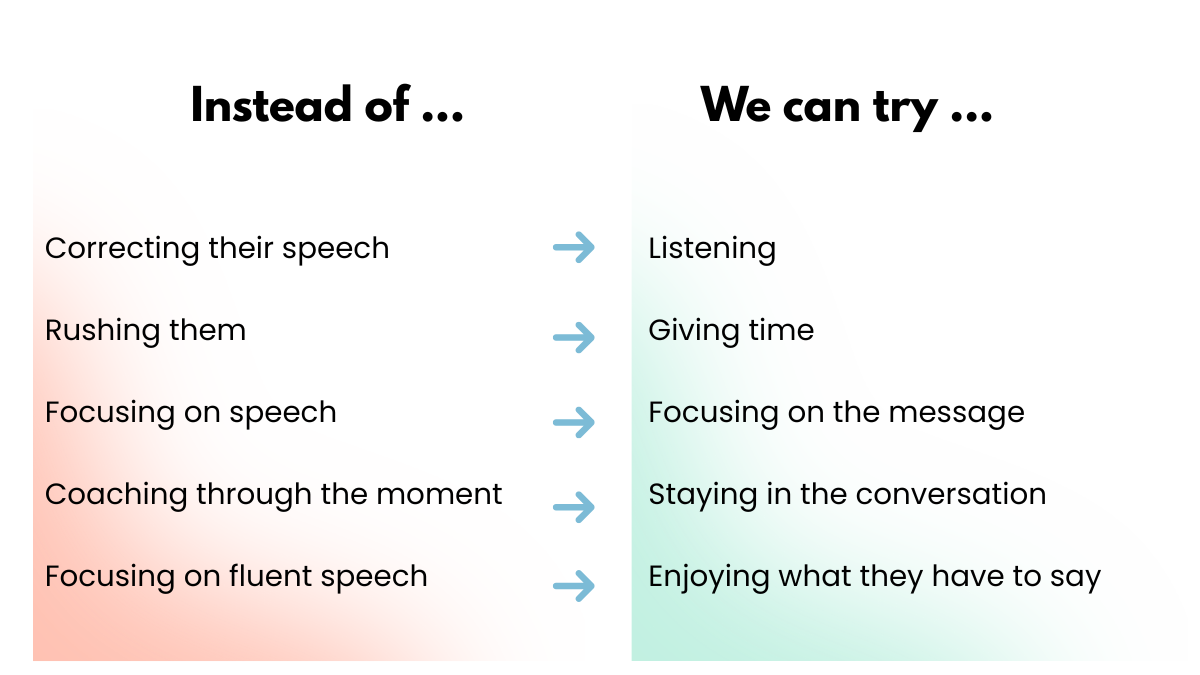
As much as possible, we can keep our attention on our child's message rather than evaluating how smoothly the words come out. We can respond naturally to their stories, ideas, questions, and humor. The ordinary conversations we already share help communicate that their voice is welcome and that what they have to say matters.
When Helping Adds Pressure
When we hear a child stuttering, it is natural to want to make speaking easier. We may find ourselves saying things like, "Slow down," "Take a breath," or "Start over."
Those suggestions usually come from care. We want to help. But when a child is repeatedly told to change the way they are speaking, they may begin to receive the message that their speech is bad or wrong. Over time, that can contribute to tension, self-consciousness, and even shame developing around speaking.
Instead, we can stay in the conversation, give them time, and show continued interest in what they have to say. We can let the moment belong to them without turning their speech into something that needs to be fixed. Often, the most supportive thing we can do is simply help our children feel heard.
We can keep enjoying their humor, curiosity, creativity, and thoughtfulness. We can stay interested in their stories, questions, and ideas.
What they have to say matters.
Support Through Professional Guidance
Sometimes parents simply want help understanding what they're seeing. A speech-language pathologist who specializes in stuttering can help us look at our child's individual experience, answer questions specific to our family, and consider whether an evaluation, therapy, or simply continued monitoring may be helpful.
Seeking guidance doesn't mean something is wrong or that therapy is necessarily needed. Sometimes having a knowledgeable person help us understand what we're seeing can make the path forward feel much clearer.
Final Thoughts
Some questions take time to answer, but the conversations we have with our children today can help shape how they experience communication for years to come. We can support our children by:
learning about stuttering
continuing to build a strong communication relationship
seeking professional guidance when we need help understanding our child's individual experience or deciding what kind of support may be helpful
We don't have to have all the answers today. We can keep learning, listening, and showing our child that what they have to say matters.
Want to Learn More?
If your child has started stuttering and you're wondering what support might look like, you can learn more about how I work with children and families.