Most people recognize stuttering when they hear someone repeat a sound or get stuck on a word, but there is much more to stuttering than what we hear. This article explores what stuttering is, how it happens, and how it can affect the experience of communication.
Stuttering Begins With Speech
Speaking feels automatic. We think of something to say, and the words seem to come out almost instantly. But behind every sentence, the brain and body complete a complex series of steps.
First, the brain chooses the words and arranges them into a message. Then it creates a motor plan for how those words will be spoken. That plan has to coordinate breathing, voicing, and dozens of small, precise movements of the lips, tongue, and jaw, all within fractions of a second.
Our ability to speak depends on the brain and speech system working together with precise timing and coordination. And somehow, most of the time, it all happens without us consciously thinking about any of it.
Human speech is a miracle.
The process looks something like this:
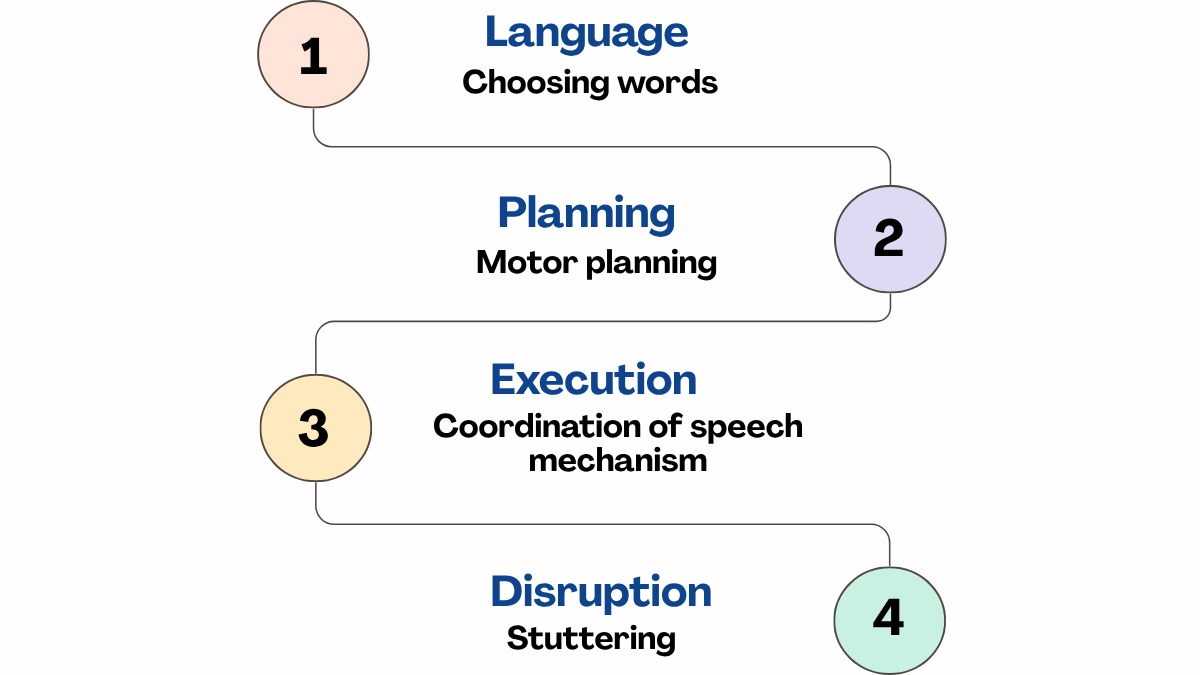
As speech and language develop during the toddler and preschool years, some children develop differences in the timing and coordination of these speech processes. Those differences can lead to developmental stuttering. Stuttering can show up in several ways.
What Stuttering Looks and Sounds Like
Repetitions
The most common way stuttering shows up is through repetitions. Most of us have repeated whole words or even whole phrases, usually when we're still thinking about what we want to say.
"We might say... we might say... we might say..."
Or...
"Or... or... or..."
But people who stutter know exactly what they want to say. The difference is that they experience a brief disruption in the timing and coordination of speech. Instead of repeating whole words or phrases, they may g-g-g-get stuck on the beginning sound of a word.
Prolongations
Some people experience prolongations. A prolongation happens when a sound is stretched out. "Ssssssometimes..." "Mmmmmmy..."
It's almost like the sound gets stuck in slow motion.
Blocks
Some people also experience blocks. A block happens when the mouth is ready to speak, but no sound comes out. Many people describe it as feeling like the word is stuck or trapped.
"I want to... (block)... get this word out."
So, stuttering begins in the brain and may show up as repetitions, prolongations, or blocks. But that's only part of the story.
What Stuttering Isn't
If there's one misconception I'd love to clear up, it’s that people don't choose to stutter. It isn't caused by anxiety, talking too fast, not knowing what to say, or something within a person's control. Stuttering is a temporary disruption in the timing and coordination of speech while a person is speaking. It is not a lack of intelligence, effort, or preparation.
Understanding that changes the way we think about stuttering. It’s the reason why well-meaning advice like "Slow down," "Take a deep breath," or "Think about what you want to say" usually isn't helpful. Those suggestions don't change the timing and coordination of speech in the brain. For people who stutter, this advice can add pressure at a time when speaking already feels difficult.
Key Takeaway
People don't choose to stutter. Stuttering is a difference in the timing and coordination of speech.
Why Does Stuttering Change?
One of the most confusing things about stuttering is that it often changes, day to day, person to person, and situation to situation. I explore this in another article Why Does Stuttering Change So Much. Stuttering, by its very nature, is unpredictable.
There's More to the Experience of Stuttering
So far, we've talked about where stuttering begins and what it sounds like. But the experience of stuttering isn't limited to what we hear. It also includes the thoughts, feelings, and reactions that can develop around communication. I explain this in Are You Stuttering or Struggling. Sometimes, the struggle that develops around stuttering becomes bigger than the stuttering itself.
The Bottom Line
Stuttering is a unique communication experience that can affect not only speech, but also thoughts, feelings, and everyday life.
Understanding helps replace judgment with compassion, so we can support the people who live with it every day.
When we know better, we do better.
Understanding Stuttering Series
This article is part of our Understanding Stuttering series. If you'd like to learn more, these articles build on one another:
What Is Stuttering?
Why Does Stuttering Change So Much?
What Causes Stuttering?
Are You Stuttering or Struggling?